Every glass of wine tells a story, and some of these stories have roots that reach far back in time, among ancient civilizations and long-forgotten winemaking techniques.
Today we would like to take you back in time, to the age of ancient Rome, to discover how our ancestors produced wine and how these techniques, hidden for centuries, continue to inspire us today.
This journey leads us directly to Eúxenos, our amphora-aged wine, born not only from a fascination with these ancient traditions but also from an incredible story we have already shared with you on other occasions.
Winemaking in ancient Rome was a complex art that combined technical knowledge with a deep understanding of materials. A central element in this process was the dolium, a large terracotta vessel with a rounded body, flat base, and wide opening, used for fermentation, storage, and aging of wine. These containers, often buried up to the rim, offered significant advantages: burial ensured stable temperatures during fermentation, while the porosity of the terracotta allowed controlled micro-oxygenation, positively influencing the wine’s aromatic profile.
An interesting comparison can be drawn between Roman dolia and Georgian qvevri, large terracotta amphorae buried underground and still used today in traditional winemaking in Georgia. Both methods rely on spontaneous fermentation driven by native yeasts found on the grape skins, and on buried vessels to maintain consistent temperatures. However, there are notable differences: while qvevri are completely buried, Roman dolia were often partially buried or placed above ground, depending on the specific needs of production.
The shape and structure of the dolia were designed to facilitate the winemaking process. Their wide openings allowed for easy cleaning and handling of the must, while their capacity, usually several thousand liters, made large-scale production possible. The porosity of the terracotta promoted slow oxygen exchange, contributing to the development of complex aromas and greater wine stability. In addition, burying the dolia helped maintain a constant temperature, essential for controlled fermentation.
A key element in dolium winemaking was prolonged contact with grape skins, a practice we now recognize in the production of so-called “orange wines.” This method gave the wine greater tannic structure and distinctive aromatic complexity. Furthermore, the formation of a yeast “flor” on the surface of the wine during fermentation helped protect it from oxidation while developing unique aromatic profiles.
Roman winemaking practices were highly sophisticated, skillfully exploiting the properties of materials and fermentation techniques to produce wines of remarkable quality. A comparative study with Georgian traditions offers valuable insight into these ancient methodologies and their impact on the sensory profiles of the resulting wines.
These techniques are not merely a testament to the past; they continue to find application in our production today. At Tenuta di Castellaro, we draw inspiration from these ancient traditions to create wines that serve as a bridge between past and present.
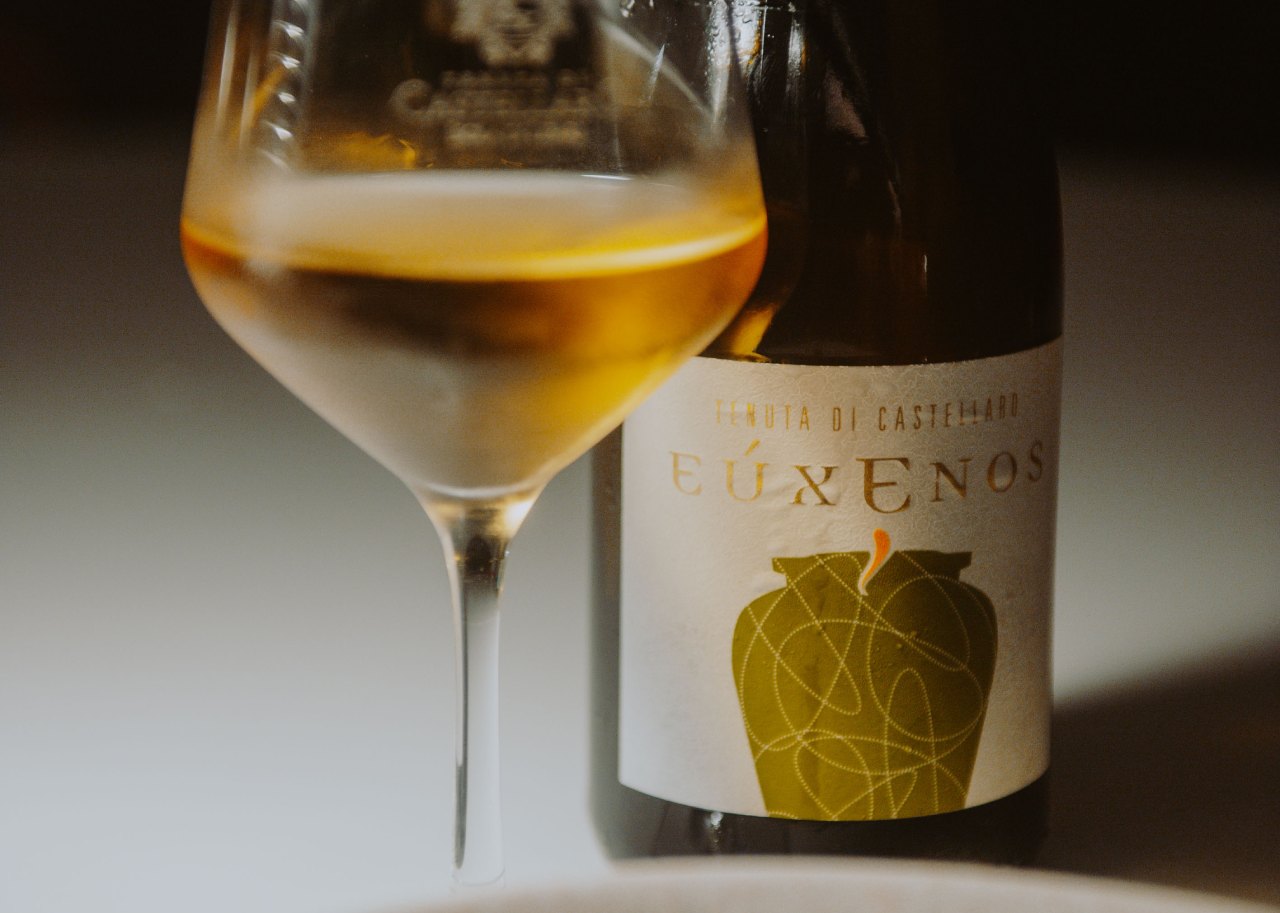
A striking example is our Eúxenos, a dry white wine made exclusively from Malvasia delle Lipari grapes. Spontaneous fermentation takes place in cocciopesto amphorae, a material used since Hellenistic and Roman times, and the wine remains in contact with the skins for over 20 days, followed by nine months of aging in amphora. This process gives the wine notes of candied and toasted fruit, with a delicate minerality, offering a sensory experience that echoes ancient winemaking techniques.
Through Eúxenos, we celebrate the richness of our enological heritage, proving that the practices of the past can still give rise to extraordinary wines today.